The shop system: vehicle history, photographed inspections, and a phone that gets answered.
A shop site, a CRM with the vehicle as the entity, and an AI that answers the phone and quotes from your labor guide. Live in 48 hours.
Both voices are synthesized and the business is one of our own examples. This is what the agent does, not a customer’s call.
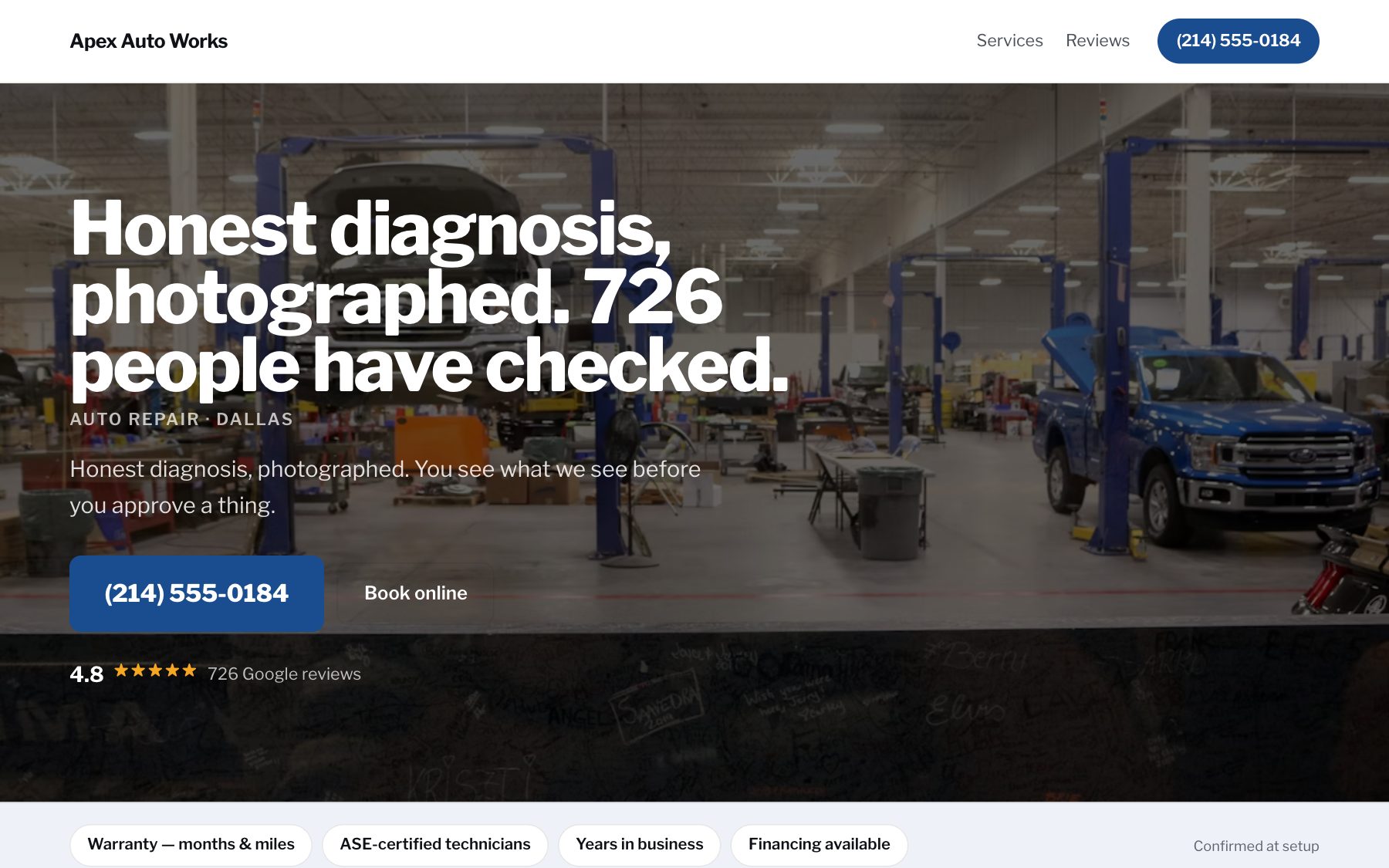
Open the live site → Warranty as two numbers, not the word available
A demonstration site for a business we invented. The rating and the review count on it are not real.
Talk to the front desk of an auto repair shop.
A live agent answering as Apex Auto Works, quoting only from that shop’s price book. Ask it for a price the book does not hold and watch it refuse rather than guess.
Call the Apex Auto Works front desk.
It answers with the recording notice, quotes only from that shop’s price book, and books against real slots — and it refuses to guess at anything the book does not contain. Ask it for a price it does not have and watch what it does.
Nothing is recorded and nothing is stored. You can type instead of talking. Both voices in the recording below are synthesized; this one is a live model answering you.
What actually books more jobs for an auto repair shop?
For an auto repair shop, the two mechanics with real evidence behind them are answering the phone and photographing the inspection. Cox Automotive found that documenting findings with photo or video raised the average repair order by $230 and made customers 49% more likely to approve the work, across a sample of 2,500 consumers. A field-service benchmark across 3,000 businesses shows shops with fewer than five technicians convert 24% of calls into booked jobs, while shops over twenty-five convert 59% — a thirty-five point gap driven by staffing and process rather than skill. Orabeam addresses both directly: the digital vehicle inspection attaches photographs to each line so the customer approves or declines individually, and the AI front desk answers every call, quotes from the shop's own labor guide within bounds the owner sets, and books against real bay availability.
Auto has the highest visit-to-lead rate of thirteen industries measured, at 7.9%, and form completion of 44.8%. The web form is the front door; the phone closes what the form starts. Ruler Analytics, form vs call split by industry · verified 31 Jul 2026
Three things we build in for auto repair shops.
One dominant scheduling action
Not four competing buttons. The reference shops run a single Schedule Your Visit and let everything else be secondary.
Warranty as two numbers
Years and miles, at hero scale — not the word 'available'. It is the objection every shop hears and most sites answer in a footer.
The inspection, photographed
Green, amber and red per line, with the picture attached. The customer approves the brake job because they saw the 3mm.
What a generic CRM cannot hold for an auto repair shop.
This is the Command tier, and it is the reason it exists. These are not custom fields.
- Digital vehicle inspection with per-line approve and decline
- Declined-work register that re-solicits on mileage, not on a date
- The vehicle as the entity, with its own service clock — a household has several
- Labor guide and effective labor rate, ARO, gross profit per repair order
- Tire storage, fleet accounts with PO and net terms, parts markup matrix
Open the auto repair backoffice
Running software. No sign-up.
Buy the software once. Pay monthly only for the AI.
Running & Care is $79 a month — roughly one booked diagnostic scan. The AI front desk plans start at $297 and include it.
Launch
$1,000 one-time, and yours
Look credible, stop losing web leads. One location.
Thirty days, three numbers, or your money back.
Growth
$1,500 one-time, and yours
The phone answered. The quote followed through.
Thirty days, three numbers, or your money back.
Command
$2,500 one-time, and yours
Multi-location, or compliance a generic CRM cannot hold.
Thirty days, three numbers, or your money back.